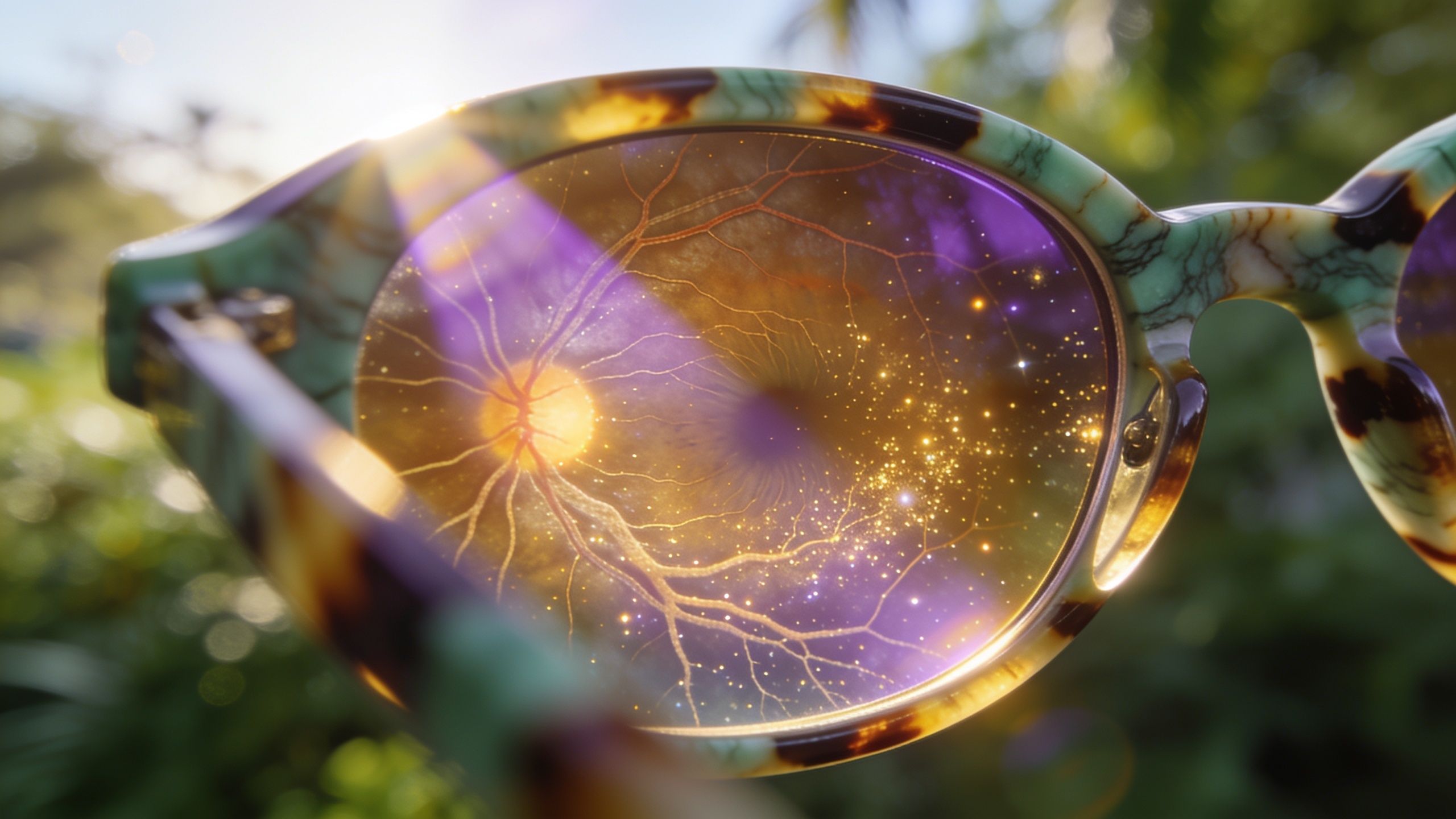
The Light We Carry: Why Your Vision in 2026 is About More Than Just Seeing
The 3 p.m. sun in Coral Springs doesn't just hit; it vibrates. By late June, the humidity on University Drive acts like a lens itself, magnifying the glare off every windshield and shop window. It’s a beautiful, blinding mess.
Most people think of eye care as a binary: you can see or you can't. But as we move through the middle of 2026, the conversation has shifted. We aren't just talking about 20/20 vision anymore. We're talking about ocular longevity, the ethics of what we wear on our faces, and the startling reality of how our digital lives are physically reshaping our children's eyes.
The Invisible Map of Your Health
Last week, I sat with a patient who came in for a simple prescription update. She felt fine. Her vision was 'good enough.' We ran an ultra-widefield retinal scan—technology that captures 200 degrees of the retina in a single flash.
In the far periphery, where no traditional lens could see, we found a small, distinct thinning. It wasn't a problem yet, but in two years, it would've been a retinal tear. This is the difference between reactive and proactive medicine. We aren't just checking if you need a new set of frames; we’re mapping the internal geography of your health. When we catch these things early, the 'treatment' is often just observation and lifestyle shifts, not surgery.
The Rise of the Conscious Frame
For years, the optical industry followed the 'fast fashion' trajectory—cheap plastics, exploitative labor, and a lifespan of maybe eighteen months. That’s dying.
In 2026, the trend we’re seeing at Modern Optical FL is Circular Eyewear. Our latest collection features frames carved from bio-acetates and recycled marine polymers. These aren't the crunchy, aesthetic-free glasses of a decade ago. They are sculptural, vibrant, and, quite frankly, better built. They have a weight and a hinge-snap that tells you they’re meant to last five years, not one.
Selecting a frame is an act of curation. You’re choosing the interface through which you see the world and the world sees you. Why should that interface be a disposable piece of petroleum?
The Myopia Crisis is Local
If you walk through Mullins Park on a Saturday, you’ll see it: kids as young as six wearing thick lenses. Global myopia (nearsightedness) rates have climbed 14% since 2020. It's not just 'too much screen time.' It’s a lack of specific outdoor light frequencies that signal the eye to stop growing.
We’ve implemented new myopia management protocols this year that go beyond standard glasses. We’re using peripheral defocus lenses—specialized tech that tells the eye to slow its elongation. It sounds like science fiction, but it’s the difference between a child having a -2.00 prescription versus a -8.00 by the time they graduate from Coral Springs High.
A Human Moment in a Digital Room
I’ve spent twenty years in this industry, and I’ve read every clinical trial on blue light and macular degeneration. But none of that matters as much as the look on a grandfather’s face when he tries on a pair of customized progressive lenses and realizes he can finally see the individual freckles on his granddaughter’s nose again.
That’s why we do this. We aren't selling plastic and glass. We’re selling the ability to participate in your own life without a blur at the edges.
If you haven't had your retinas mapped this year, you're looking at an incomplete picture.
Stop by the boutique on University Drive. Let's look at the data, find the frames that match your soul, and make sure you're seeing the Florida sun safely.
Leave a Reply